Characterization for both CellInject™ and I-CAN™ technologies:

CellInject™ Technology is innovative proprietary solid lipid nanoparticle technology for intracellular release of Active Substances
CellInject™ particles main characteristics
Size
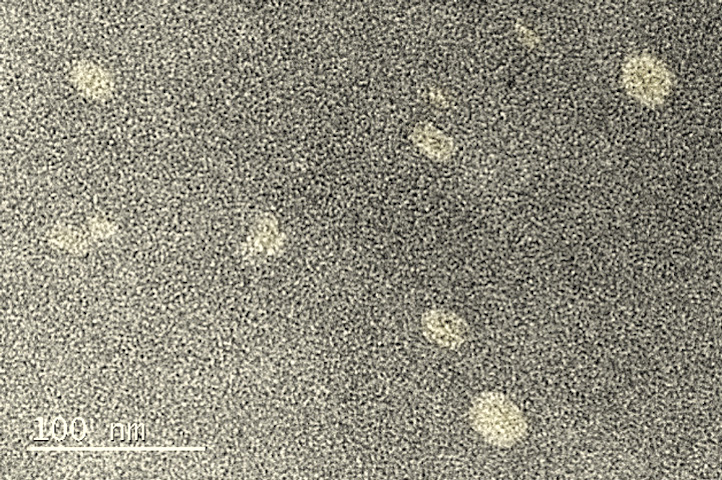
Transmission Electron Microscope micrograph of CellInject™ particles
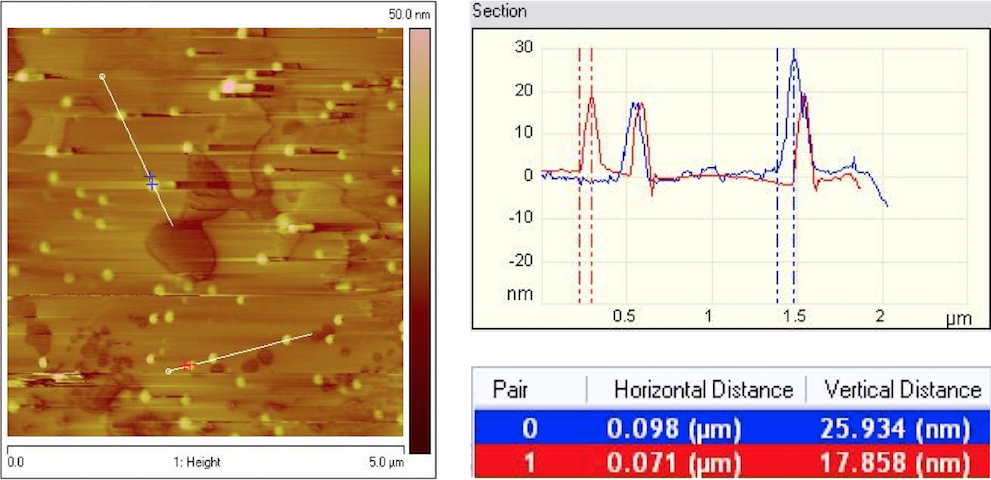
Atomic Force Microscope micrograph of CellInject™ particles
- CellInject™ particles are separate, with no tendency to form clusters as confirmed by TEM and AFM micrographs. The particles are spherical to oval in shape. Individually measured particles have size in the range 20 nm and 30 nm.
Size, polydispersity and z-potential of tested SLNs dispersions.
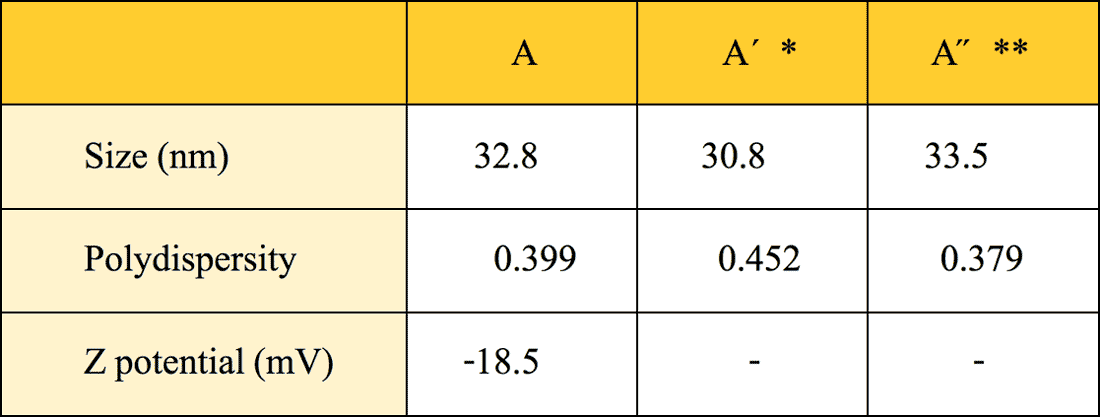
A – CellInject™ particles.
A’ – CellInject™ particles after incubation at 37°C for 24h with pancreatic lipase.
A” – CellInject™ particles after incubation at 37°C
for 2h with bovine serum albumin.
A’ – CellInject™ particles after incubation at 37°C for 24h with pancreatic lipase.
A” – CellInject™ particles after incubation at 37°C
for 2h with bovine serum albumin.
* The particles are not sensitive to pancreatic lipase.
** The particles are not adhesive to albumin and other soluble proteins and do not form protein corona.
** The particles are not adhesive to albumin and other soluble proteins and do not form protein corona.
- CellInject™ is resistant to pancreatic lipase.
- CellInject™ is not adhesive to albumin and other soluble proteins and do not form protein corona.
- DLS analysis reveals monomodal size distribution.
- CelInject™ technology produces yield of over 96% in the range between 20nm and 30nm.
- Entrapment efficiency for lipophilic active substances is > 98.0%. The entrapment efficiency of CellInject™ loaded with 0.01% Mometasone furoate is 98.8%.
Dissolution rate of 0.01 % Mometasone furoate loaded particles
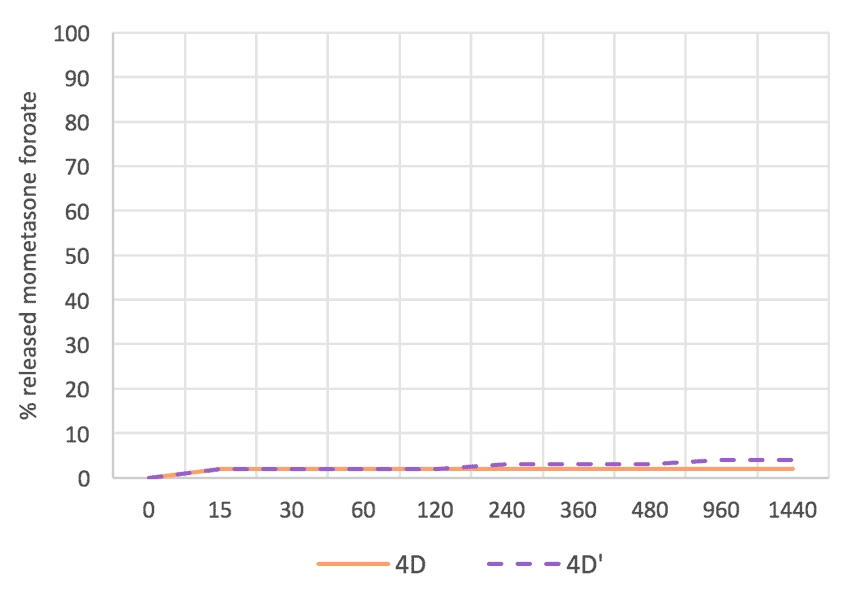
CellInject™ does not release Mometasone furoate after 24h dissolution test (4D).
CellInject™ does not release Mometasone furoate after 24h dissolution test in the presence of pancreatic lipase (4D`).
CellInject™ does not release Mometasone furoate after 24h dissolution test in the presence of pancreatic lipase (4D`).
- Mometasone furoate release from CellInnject™ in purified water (4D) and in pancreatic lipase 200 UI/g (4D`)
Physical stability
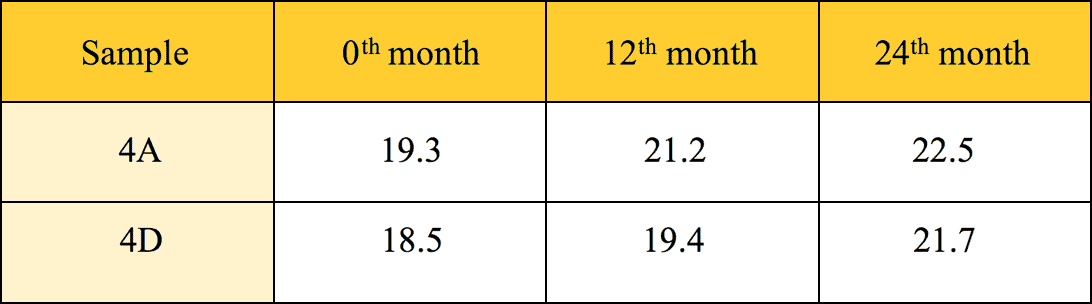
Changes in particle size (nm) were studied over a period of 24 months at 25°C.
- Slight but not meaningful increase in the mean particle size is observed after 24 months of test at 25°C

I-CAN™ Technology is Mucoadhesive dispersion system with integrated CellInject™ nanoparticle technology, intended to be applied to mucosal surfaces and ensuring highest particle bioavailability.
I-CAN™ Technology main characteristics
Viscosity
The viscosity measurements are made at two temperature levels, assuming the temperature of storing and temperature within the nasal cavity.
- The viscosity of I-CAN™ system is 2.7 mPa.s at 25°C and is low enough to be easily sprayed from standard spray pump device.
- The viscosity of 1.8 mPa.s at 33°C allows fast and easy distribution of the applied dose over a large mucosal surface.
Adhesiveness
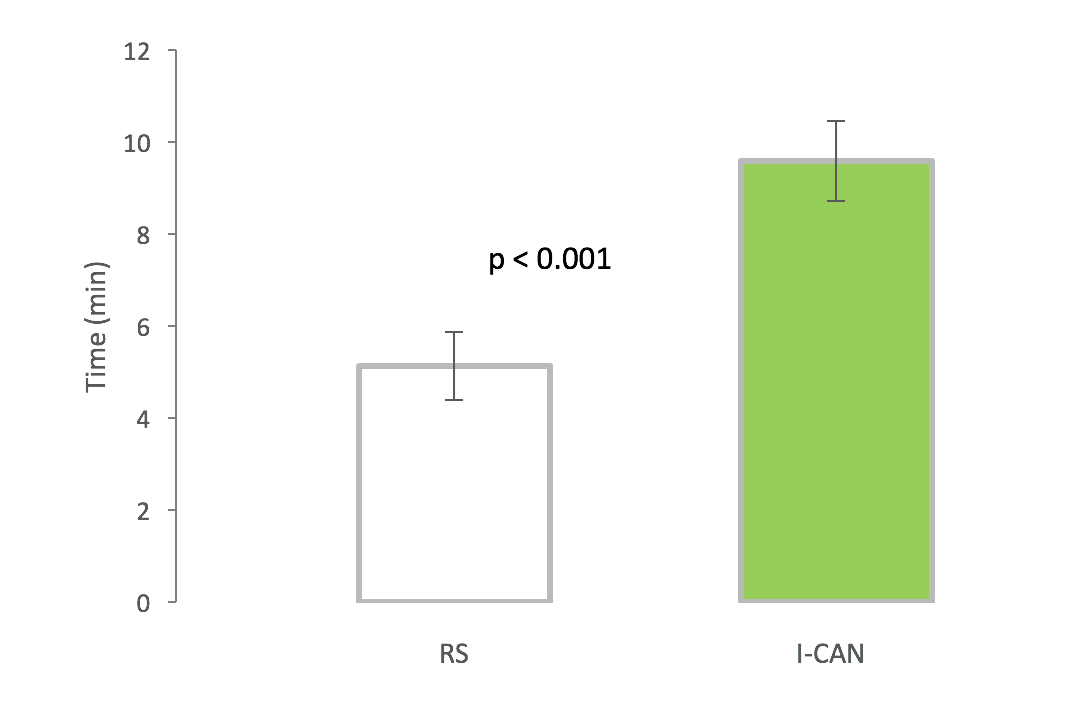
Adhesiveness test is based on measurement the nasal clearance times of reference solution (RS) and from I-CAN™ spray system.
- Increase of 87% in the nasal clearance was measured with I-CAN™ system.